
I’ve always had a soft spot for the Ricoh GR line. Not because it’s the flashiest gear on the market, but because it represents something I genuinely believe in: a small, no-nonsense tool that gets out of your way and lets you shoot. When I started out with a $300 kit camera, I learned pretty fast that the camera you actually carry beats the one sitting at home in a padded bag. The GR is basically built around that philosophy. So when I came across a new video from Sean Tucker, a photographer who’s made the GR series a core part of his street work, testing the brand new GR IV in Skiathos, Greece, I paid attention.
Watch the full tutorial on YouTube
What makes Tucker’s take worth your time is that he’s not doing a spec-sheet rundown. He’s actually been using the previous GR3 and GR3X in the field for years, and both broke on him in the same way. That kind of honesty is rare, and it reframes the whole conversation around the GR IV as something more useful: not “is this camera good?” but “did Ricoh actually fix what was broken?” Here’s what he walks through, and what it means if you’re trying to decide whether to buy, upgrade, or skip.
Step 1: Understand the Context Before You Judge the Camera
 Sean Tucker walking through narrow streets of Skiathos with camera
Tucker is testing this camera under real travel conditions, not in a studio. He’s on a Greek island for a family wedding, shooting in stolen moments between events. That matters because it mirrors exactly how most of us actually use a compact camera. You’re not on a dedicated photo trip. You’re at a reunion, a vacation, a birthday weekend, and you want something that can keep up without becoming a whole production. Keep that framing in mind as you evaluate every feature he mentions.
Sean Tucker walking through narrow streets of Skiathos with camera
Tucker is testing this camera under real travel conditions, not in a studio. He’s on a Greek island for a family wedding, shooting in stolen moments between events. That matters because it mirrors exactly how most of us actually use a compact camera. You’re not on a dedicated photo trip. You’re at a reunion, a vacation, a birthday weekend, and you want something that can keep up without becoming a whole production. Keep that framing in mind as you evaluate every feature he mentions.
Step 2: Know the Scroll Wheel Problem Before You Dismiss It
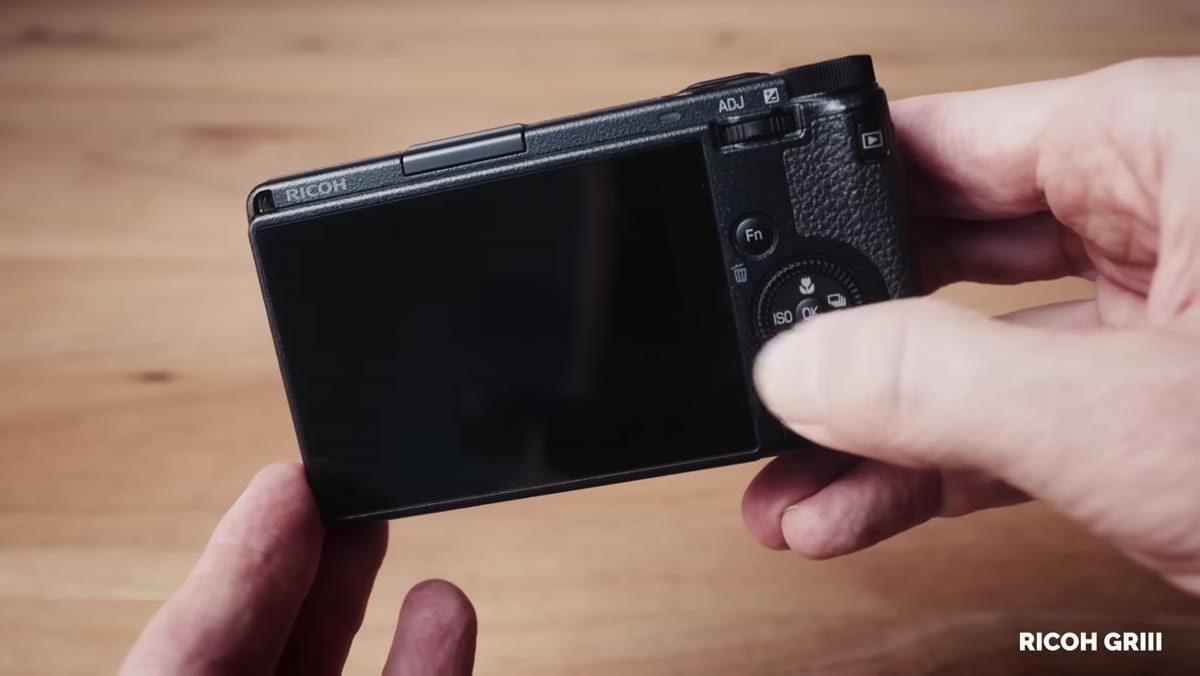 Close-up of the rear dial area on the Ricoh GR body
Tucker’s GR3 and GR3X both died the same death: the rear scroll wheel stopped working reliably. This wasn’t a rare fluke. He mentions knowing other GR users who hit the same issue. The scroll wheel handled two critical functions, reviewing images after a shoot and adjusting ISO on the fly. For anyone shooting manual, losing ISO control is a dealbreaker. If you’re considering a used GR3 right now, this is the first thing to physically test in your hands before handing over any money. Scroll it hard, both directions, multiple times.
Close-up of the rear dial area on the Ricoh GR body
Tucker’s GR3 and GR3X both died the same death: the rear scroll wheel stopped working reliably. This wasn’t a rare fluke. He mentions knowing other GR users who hit the same issue. The scroll wheel handled two critical functions, reviewing images after a shoot and adjusting ISO on the fly. For anyone shooting manual, losing ISO control is a dealbreaker. If you’re considering a used GR3 right now, this is the first thing to physically test in your hands before handing over any money. Scroll it hard, both directions, multiple times.
Step 3: See Why the Rocker Switch Replacement Actually Matters for Manual Shooters
 Tucker demonstrating finger position on the new GR IV rocker switch
Ricoh’s fix on the GR IV was to ditch the scroll wheel entirely and go back to the rocker switch design from the older GR2. For Tucker, this restores a three-control setup he relies on: shutter speed on one dial, aperture on another, and ISO on the rocker switch under his finger. If you shoot manual, that triangle of controls needs to be muscle memory. The GR IV puts them back in positions your hands can find without looking, which is exactly what you need when you’re lifting the camera fast in a crowded street scene.
Tucker demonstrating finger position on the new GR IV rocker switch
Ricoh’s fix on the GR IV was to ditch the scroll wheel entirely and go back to the rocker switch design from the older GR2. For Tucker, this restores a three-control setup he relies on: shutter speed on one dial, aperture on another, and ISO on the rocker switch under his finger. If you shoot manual, that triangle of controls needs to be muscle memory. The GR IV puts them back in positions your hands can find without looking, which is exactly what you need when you’re lifting the camera fast in a crowded street scene.
Step 4: Evaluate the Dust Ingestion Fix With Realistic Expectations
 Tucker explaining lens retraction mechanism on the GR IV
One of the GR line’s persistent complaints has been that when the lens retracts on shutdown, it can pull dust back toward the sensor. Since the sensor on these cameras is not user-serviceable, that means a service center trip every time. On the GR IV, Ricoh has significantly improved the seal around the retracting lens to reduce how much dust gets through. Tucker presents this as a genuine improvement, not a total solution. If you’re shooting in seriously dusty environments, you’ll still want to think about how you’re powering down the camera. Turn it off in your pocket, not mid-dust-storm.
Tucker explaining lens retraction mechanism on the GR IV
One of the GR line’s persistent complaints has been that when the lens retracts on shutdown, it can pull dust back toward the sensor. Since the sensor on these cameras is not user-serviceable, that means a service center trip every time. On the GR IV, Ricoh has significantly improved the seal around the retracting lens to reduce how much dust gets through. Tucker presents this as a genuine improvement, not a total solution. If you’re shooting in seriously dusty environments, you’ll still want to think about how you’re powering down the camera. Turn it off in your pocket, not mid-dust-storm.
Step 5: Put the Battery Life Improvement in Actual Perspective
 Tucker holding the GR IV while discussing battery size change
The GR IV ships with a physically larger battery than its predecessors, and it does last longer per charge. Tucker is upfront that he hasn’t noticed a dramatic difference personally, and he explains why: he keeps the camera off whenever he’s not actively shooting. The GR series powers up in under a second, fast enough that by the time he raises the camera to frame a shot, it’s already ready to fire. If you shoot the same way, keeping the camera off between moments rather than leaving it in sleep mode, the old battery already lasted days. The new one just gives you a bit more buffer, which is never a bad thing, but it’s not a reason to upgrade on its own.
Tucker holding the GR IV while discussing battery size change
The GR IV ships with a physically larger battery than its predecessors, and it does last longer per charge. Tucker is upfront that he hasn’t noticed a dramatic difference personally, and he explains why: he keeps the camera off whenever he’s not actively shooting. The GR series powers up in under a second, fast enough that by the time he raises the camera to frame a shot, it’s already ready to fire. If you shoot the same way, keeping the camera off between moments rather than leaving it in sleep mode, the old battery already lasted days. The new one just gives you a bit more buffer, which is never a bad thing, but it’s not a reason to upgrade on its own.
Step 6: Apply Tucker’s Shooting Rhythm to Your Own Compact Camera Work
 Tucker walking through market area, camera held down at his side
The most transferable thing in this entire video has nothing to do with the GR IV specifically. Tucker describes walking with the camera off and loose in his hand, turning it on only when something catches his eye, and trusting the camera’s startup speed to close the gap. This is a discipline, not a feature. Most of us leave cameras on, run down the battery, and then fumble with menus when something actually happens. Try his approach for a single afternoon: camera off, hand relaxed, shoot only when something earns it. The GR IV makes this easy, but you can practice the mindset with almost any fast-starting compact.
Tucker walking through market area, camera held down at his side
The most transferable thing in this entire video has nothing to do with the GR IV specifically. Tucker describes walking with the camera off and loose in his hand, turning it on only when something catches his eye, and trusting the camera’s startup speed to close the gap. This is a discipline, not a feature. Most of us leave cameras on, run down the battery, and then fumble with menus when something actually happens. Try his approach for a single afternoon: camera off, hand relaxed, shoot only when something earns it. The GR IV makes this easy, but you can practice the mindset with almost any fast-starting compact.
What I’d Add: The Used GR3 Question Right Now
Here’s the thing nobody says out loud when a new model drops: the used market on the GR3 just got more interesting. Prices will drift down as GR IV buyers sell their old bodies. If you can physically inspect a used GR3 and confirm the scroll wheel works cleanly, you’re potentially looking at a capable street camera at a real discount. The sensor, the lens, and the form factor haven’t changed dramatically enough to make a working GR3 irrelevant. I’d still take one over most cameras twice its used price, as long as you go in knowing the scroll wheel is the thing to watch. Check it twice, and negotiate accordingly if there’s any hesitation in the action.
Tucker’s takeaway, and mine after watching this, is simple: the GR IV is a refinement, not a revolution. Ricoh listened to the actual complaints, fixed the scroll wheel, improved the dust sealing, and bumped the battery. That’s not exciting headline material, but it’s exactly what you want from a tool you’re going to carry every day. The camera that doesn’t break, powers up fast, and stays out of your way is worth more than the one with specs nobody uses.
Watch the full tutorial on YouTube to see the GR IV in action on the streets of Skiathos and hear Tucker’s full take on whether it’s replacing his old kit.
Comments
Leave a Comment